· 11 min read
Making Sound Business Decisions: A Practical AI-Assisted Framework
A decision can look obvious when a solution arrives first. A vendor promises faster collections, an executive proposes an AI agent, or a team sees a competitor automate customer follow-up. The real question is whether that solution addresses the business problem, creates measurable value, and protects the customer relationships the company depends on.
This guide turns that question into a repeatable practice. It follows three moves: frame the underlying problem, compare options against business impact, then commit with checkpoints so the organization can learn and adapt. AI tools such as Codex and Claude Code can help challenge assumptions, inspect evidence, calculate scenarios, and surface overlooked alternatives. People still own the decision.
The worked example concerns a fictional company with overdue invoices and inconsistent follow-up. All amounts, probabilities, scores, organizations, and outputs below are illustrative. Replace them with evidence from your own business before acting.
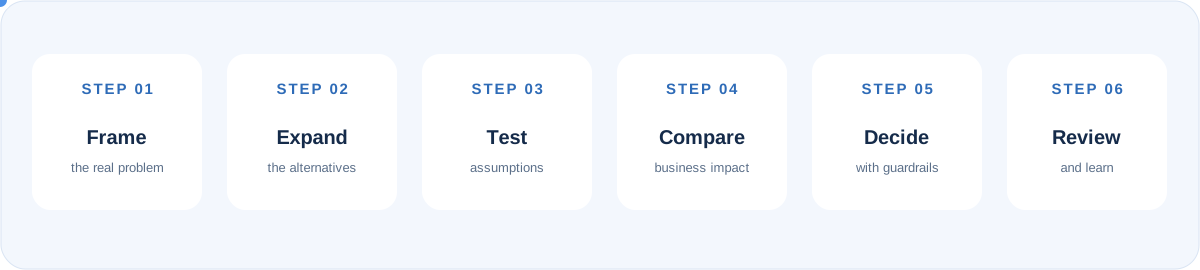
1. Frame the real problem before evaluating solutions
The first proposal is an anchor: it draws attention toward one answer before the group has agreed on the question. “We need an AI collections agent” is a proposed solution. A better decision statement is: “How might we reduce avoidable overdue receivables over the next two quarters while preserving customer trust, keeping staff in control of sensitive cases, and staying within our delivery budget?”
That framing makes the desired outcome, time horizon, constraints, and human impact visible. It also creates room for answers besides buying a tool. In the fictional company, the team first checks the evidence: days-sales-outstanding (DSO) by customer segment, dispute rates, invoice accuracy, time from due date to first reminder, promise-to-pay outcomes, and complaints after collection contact. If incorrect invoices cause most delays, automating reminders would accelerate the wrong process.
Two common biases can distort this work. Anchoring gives too much weight to the first number, vendor proposal, or senior person’s preferred answer. Confirmation bias leads the group to seek evidence supporting its favored option while explaining away contrary signals. Make both testable: record the initial recommendation and its assumptions, ask what evidence would change the team’s mind, and deliberately assign someone to argue the strongest opposing case.
Ask an AI coding assistant to widen the option set before scoring anything. Give it a short, anonymized decision brief and ask for meaningfully different interventions, not cosmetic variations of the first idea. For the receivables case, options might include fixing invoice-data defects, clarifying payment terms at sale, prioritizing high-risk accounts for human follow-up, coaching the collections team, adding a customer self-service route, piloting AI-drafted reminders for staff approval, or buying a fully automated platform. Include “do nothing for now” as a baseline.
Then run a pre-mortem: imagine the chosen option has failed six months after launch. Ask the team to independently list why, before discussing the answers. The AI pilot could send an incorrect balance because credits were missing, contact a customer during an active dispute, use an inappropriate tone, or generate reminders with no traceable source. Turn each failure story into a prevention, detection, or escalation control. For example, suppress disputed accounts, show the invoice and ledger evidence beside every draft, require human approval, and measure complaint rates alongside collection speed.
Codex / Claude Code prompt — frame and challenge the decision
Act as a skeptical decision analyst. Read only the files in ./decision-brief/.
Do not edit files, contact anyone, browse externally, or assume missing facts.

Decision we are considering: [write the proposed action]
Business outcome and deadline: [state measurable outcome and date]
Constraints: [budget, policy, customer, people, technology]

Return:
1. The underlying problem in one sentence, separately from the proposed solution.
2. A table of claims labelled evidence, assumption, inference, or unknown,
   with the source file and page/row for each evidence item.
3. Possible anchoring and confirmation-bias risks, including evidence that
   could disconfirm the preferred option.
4. At least eight distinct alternatives, including process, people, policy,
   technology, staged pilot, and do-nothing options.
5. A pre-mortem: ten plausible failure causes, early warning signs, and
   prevention or mitigation actions.
6. The three facts we should verify before comparing options.

Do not recommend a winner yet. Do not invent data or citations.
2. Compare options using business impact and structured evidence
Once the problem and alternatives are clear, agree the criteria before seeing the scores. Weighted criteria make trade-offs explicit; they do not turn judgment into objective truth. In this example, the leadership team weights revenue and working-capital impact at 35%, customer outcomes and trust at 25%, cost and delivery effort at 20%, and operational, compliance, and execution risk at 20%. Each alternative receives a 1–5 rating, where 5 is most favorable. The weighted total is the sum of each rating multiplied by its weight.
Option A — Automate reminders first. Revenue and cash impact: 4/5. Customer trust: 2/5. Cost and effort: 3/5. Risk: 2/5. Weighted score: 2.90/5.
Option B — Fix the workflow, train staff, and pilot AI drafts. Revenue and cash impact: 3/5. Customer trust: 5/5. Cost and effort: 4/5. Risk: 4/5. Weighted score: 3.90/5.
Option C — Buy a new collections platform. Revenue and cash impact: 3/5. Customer trust: 3/5. Cost and effort: 2/5. Risk: 2/5. Weighted score: 2.60/5.
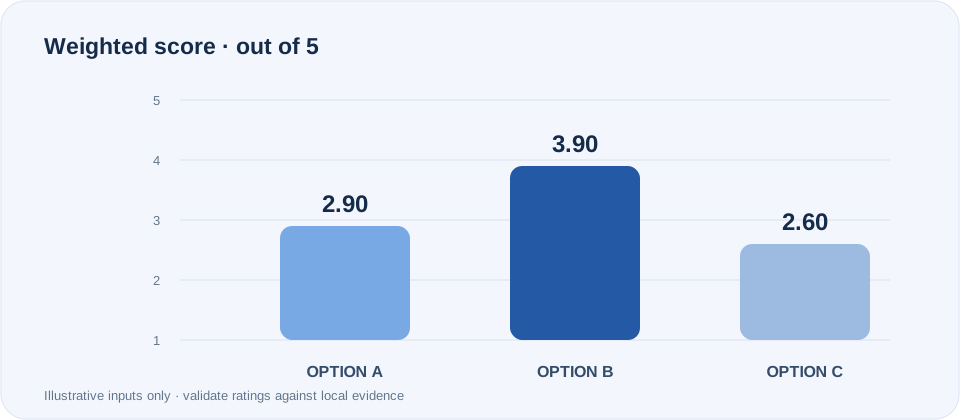
The ratings are hypotheses, not findings. Option B leads because it combines workflow repair, staff judgment, and a bounded AI pilot; the team should still test whether those ratings are supported. Ask the assistant to show the calculation, identify which assumptions could change the ranking, and run sensitivity checks. If a small change in one uncertain score makes another option win, the result is fragile and calls for more evidence or a smaller pilot. Avoid false precision: a score of 3.90 is not a 3.90-level guarantee of success.
Expected value can help compare uncertain outcomes, provided the probability and value estimates are visible. Suppose a limited pilot is expected to deliver a net benefit of $60,000 if it succeeds and a net loss of $18,000 if it fails. At a provisional 60% chance of success, expected value is (0.60 × $60,000) + (0.40 × −$18,000) = $28,800. The break-even success probability is $18,000 ÷ ($60,000 + $18,000), or about 23%. These figures are not a forecast; they are a way to expose what leaders need to validate. Test a low, central, and high case, and include cash timing, implementation effort, customer harm, and the cost of waiting where relevant.
Scale analysis to reversibility. A two-week, tightly scoped test with human approval, no production integration, and a clear stop rule is relatively reversible. A multi-year contract, irreversible staff reduction, or autonomous customer-contact rollout is much harder to unwind. The less reversible the choice, the stronger the evidence, controls, consultation, and staged approval should be. A small experiment should still have privacy, security, and customer safeguards.
Codex / Claude Code prompt — pressure-test the matrix and expected value
Use the decision brief and scoring rubric in ./decision-brief/.
Treat every score and probability as uncertain unless supported by evidence.
Do not change source files. Show formulas and cite file plus page/row.

1. Recalculate each weighted score and expected-value case independently.
2. Flag double-counted criteria, missing stakeholders, and mismatched time horizons.
3. Vary the three least-certain ratings and success probabilities. Show the
   break-even values and the combinations that change the preferred option.
4. Identify non-financial downside that the expected-value total could hide.
5. Propose the smallest safe, reversible pilot that would resolve the most
   decision-critical uncertainty, with metrics and stop conditions.
6. List what needs a human, legal, finance, security, or customer review.

Separate sourced facts from your own analysis. If inputs are missing, ask for
them or show a range; never fill the gap with an invented point estimate.
3. Use Codex or Claude Code as a pressure-testing partner
Codex and Claude Code can work with project files and, depending on setup and permissions, run local commands or help analyze structured evidence. That makes them useful for a decision pack containing an anonymized brief, policy extracts, process maps, and a small approved data sample. Codex has official documentation for its CLI and coding workflows; Anthropic documents Claude Code’s command-line workflows. Tool access and approval controls differ by configuration, so begin with read-only analysis and follow your organization’s security rules.
Give the assistant a bounded task: inspect these files, identify contradictions, compute the stated formula, and return a reviewable report. Ask it to label evidence versus inference and link each claim to its source. Then challenge the answer: “What would make this conclusion wrong?”, “Which alternative did you dismiss too quickly?”, and “What is the cheapest test that could change our choice?” Use a second pass with the opposing position, or ask a colleague to review the assumptions independently.
An AI agent is not an independent auditor. It can miss context, misread a spreadsheet, repeat errors in source data, or produce a convincing rationale for weak assumptions. Do not put confidential or personal data into an unapproved tool. An AI-generated calculation should be checked with a spreadsheet or deterministic code, and high-impact decisions need accountable human review.
Illustrative mock result — a pressure-test summary, not an actual model run
Potential ranking reversal: Option B assumes staff can resolve disputes quickly. The brief contains no measured dispute-resolution time. If dispute resolution remains slow, AI-drafted follow-up may increase complaints rather than cash collection.
Overlooked alternative: Test invoice accuracy and payment-term clarity on one customer segment before sending any AI-assisted reminders.
Decision-changing evidence: Current dispute rate, avoidable invoice-error rate, promise-to-pay completion, and complaint rate by contact type. Obtain a baseline before the pilot.
4. Commit with a clear rationale and stakeholder buy-in
When the team decides, communicate the outcome and the reasoning together. A useful decision memo states the problem, the selected option, why it fits the agreed criteria, what alternatives were considered, which assumptions remain uncertain, who owns delivery, and what evidence would trigger a change. Acknowledge the trade-off plainly: “We are choosing the staff-approved pilot over full automation because customer trust and reversibility matter while the dispute baseline is unknown.”
Invite affected people into the design before launch. Finance can validate cash and accounting measures; customer-facing colleagues can assess tone and exceptions; technology and security can set access boundaries; customers can reveal friction the internal team cannot see. Buy-in is not unanimous enthusiasm. It is shared understanding of the decision, the guardrails, and how concerns will be heard.
Set the checkpoint before the work starts. For the fictional pilot, collect a four-week baseline, run an eight-week test on a defined segment, and review weekly operational indicators. Measures might include median days to first follow-up, promise-to-pay completion, overdue balances, staff time, invoice disputes, opt-outs, and complaints. Set a stop condition in advance—for example, pause if incorrect-balance contacts exceed an agreed threshold or complaints materially rise—and a success condition tied to verified cash improvement without deterioration in customer outcomes.
5. Learn from the outcome, not just the result
At the checkpoint, compare actual results with the baseline and the decision memo. Separate decision quality from outcome luck. A sound decision uses the evidence available at the time, tests the important assumptions, and protects against foreseeable downside. It can still produce a poor result because an external event changed the conditions. A weak process can also get lucky. Judge the reasoning and controls, not only whether the metric went up.
Run a short retrospective with four questions: What did we expect? What happened? Which assumptions held or failed? What should we keep, change, stop, or test next? Preserve the original forecasts and rationale so hindsight does not rewrite what the team believed. Update the decision log with new evidence and an owner for each action.
Reverse or adjust when pre-agreed evidence crosses a threshold, a critical assumption is disproved, the risk changes, or a safer alternative becomes available. For example, rising complaints alongside unchanged collections is a reason to stop AI-assisted reminders and investigate; improved collections with stable trust may justify a carefully scoped expansion. New evidence should reopen the decision, not trigger an automatic defense of sunk costs.
6. Apply the same discipline to finance decisions
This framework aligns with the practical approach in The Impact of AI in Financial Decisions: use prompts to interrogate a decision, make assumptions visible, examine scenarios, and keep governance and accountability in view. For example, when investigating a budget variance, ask an AI assistant to separate observed movements from possible causes, identify missing data, and propose tests for each explanation. Do not let a plausible narrative substitute for ledger evidence or a finance professional’s review.
For an investment thesis, ask the tool to construct the strongest case against the proposed investment, identify which assumptions drive the return, and show what evidence would invalidate them. That is the same discipline as challenging the first solution in a business meeting. AI can widen analysis and make questioning more systematic; professionals remain responsible for materiality, accounting context, risk, and the final decision.
7. A reusable decision brief
Before your next consequential choice, write one page with these fields: decision question and deadline; underlying problem; desired business outcome and baseline; stakeholders and constraints; evidence, assumptions, and unknowns; alternatives including a staged test and do-nothing baseline; weighted criteria; expected-value ranges; reversibility and safeguards; decision owner; success and stop conditions; checkpoint date; and the evidence that would cause a reversal. Give an AI tool the brief only when its data handling is approved, then use its critique to improve the questions—not to outsource accountability.
Sound decisions are not made by eliminating uncertainty. They are made by exposing it, testing the assumptions that matter, choosing a proportionate next step, and learning honestly from what follows. Use Codex or Claude Code to widen the search and pressure-test the case. Use your people, evidence, and controls to decide what the business should do.